.png)
Swiss German for expats: The complete guide to dialects, pronunciation, and everyday communication
Dialects, pronunciation, workplace communication, and how to actually start understanding Swiss German
Table of contents
- What can actually be called Swiss German?
- The three layers of language in Switzerland
- The main Swiss German dialects
- Why Swiss German sounds so different from Hochdeutsch
- Swiss German at work
- A few common Swiss German words to know
- Common misconceptions expats have about Swiss German
- How to actually start learning Swiss German
- How XLINGUA supports this
- Conclusion
- Frequently asked questions
Swiss German isn't something you can just look up and study the way you'd study Hochdeutsch. It's a family of spoken dialects, no standard spelling, no textbook grammar, that most German-speaking Swiss people use for pretty much everything except writing. That's exactly why it trips people up. You can spend a year on Hochdeutsch, pass every exam, and still stand in an office kitchen not understanding a word.
That gap, between understanding a language on paper and actually functioning in it out loud, is what we call the Speaking Gap™. Nowhere in Switzerland is it wider than between Hochdeutsch and Swiss German. Closing it has less to do with grammar and more to do with recognising a mostly unwritten layer of the language that most courses never touch.
This guide covers what Swiss German actually is, how the dialects differ, why it sounds so different from the German you studied, and realistic ways to start understanding, and eventually speaking, it.
What can actually be called Swiss German?
Swiss German, or Schweizerdeutsch, is the umbrella term for the Alemannic dialects spoken across German-speaking Switzerland. It's not a simplified or "broken" version of Hochdeutsch. It developed alongside Standard German, not from it, and has its own sound system, vocabulary, and grammatical patterns that don't appear in written German at all.
The thing that actually defines it for a learner is diglossia. Hochdeutsch gets used almost exclusively in writing, emails, contracts, news, and textbooks, while Swiss German handles nearly all spoken communication, from family dinners to boardroom small talk. There's no real Swiss equivalent of "proper spoken German." Dialect is the default, not a casual fallback.
For the bigger picture, including how this fits alongside Hochdeutsch, permits, and citizenship requirements, see our complete guide to learning German in Switzerland.
The three layers of language in Switzerland
English, Hochdeutsch, and Swiss German rarely work as three interchangeable options. In practice they stack, and most expats move through them in roughly the same order.
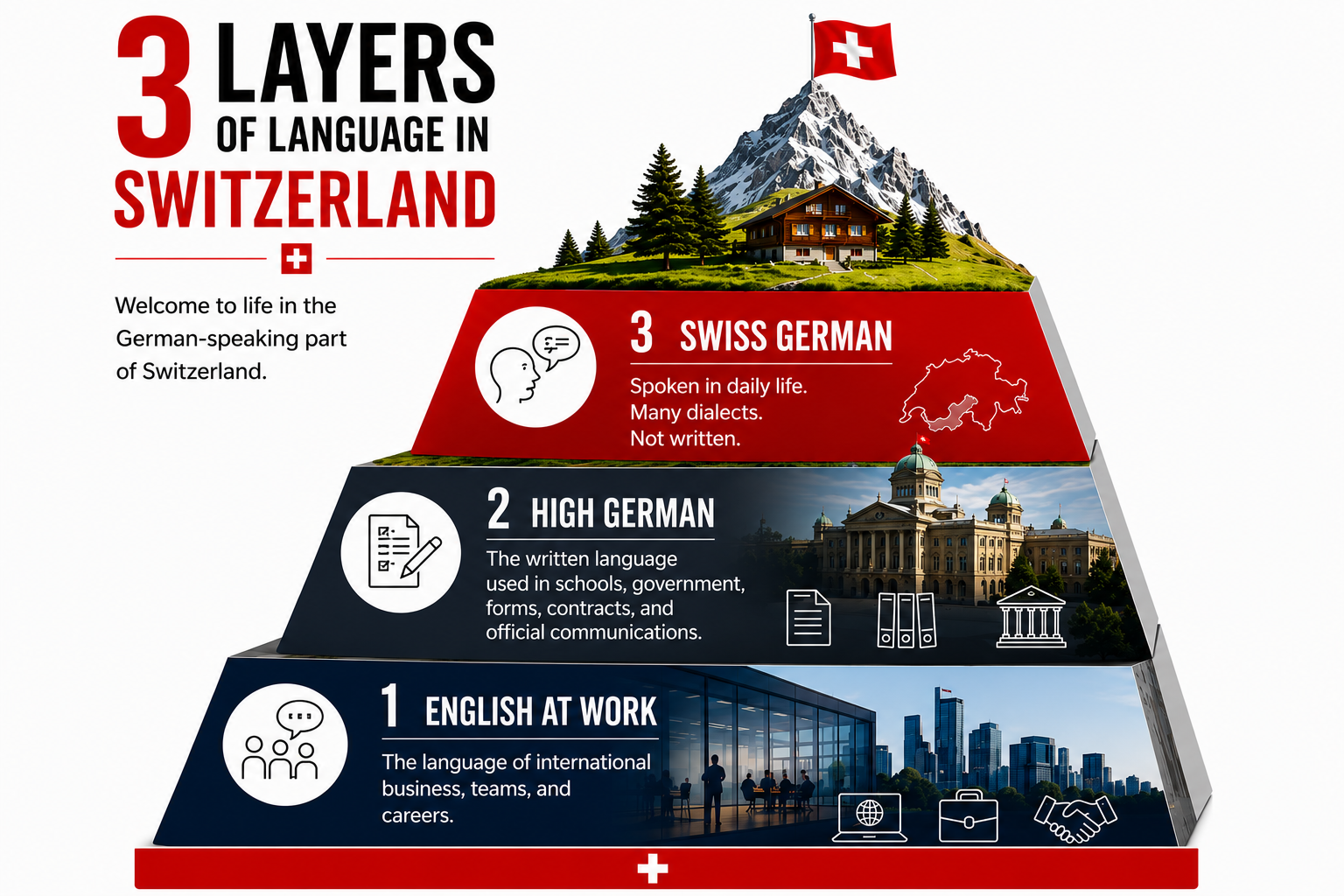
English gets most newcomers through the first stretch. Hochdeutsch becomes necessary once contracts, official letters, or school administration show up, and it's what most structured courses teach, since it's the layer that's actually written down and testable. Swiss German is the layer that quietly decides whether someone feels like an insider or an outsider day to day, and it's exactly the layer most people plateau in front of, because it's rarely taught directly and almost never written consistently.
The main Swiss German dialects
Swiss German isn't one dialect either. It shifts noticeably from canton to canton, sometimes valley to valley, and locals usually clock someone's dialect almost instantly.
| Dialect | Region | What stands out |
|---|---|---|
| Zurich German (Züridütsch) | Zurich and surrounding areas | Often the first dialect expats hear, widely used in media and business |
| Bernese German (Bärndütsch) | Bern and the surrounding canton | Slower rhythm, distinct vowel sounds, one of the most recognisable dialects |
| Basel German (Baseldytsch) | Basel | Sharper consonants, some vocabulary closer to neighbouring French and German border regions |
| Valais German (Wallisertiitsch) | Valais | One of the most distinct dialects, harder even for other Swiss German speakers to follow |
None of these is "more correct" than the others. A word that's completely normal in Zurich can sound unfamiliar in Bern, and native speakers navigate that constantly without giving it a second thought. For a newcomer, the practical takeaway is simpler than it sounds: pick a dialect based on where you actually live and work, rather than trying to learn some "generic" Swiss German that doesn't really exist.
Why Swiss German sounds so different from Hochdeutsch
A few things explain most of the initial confusion.
1. The sounds themselves are different
Swiss German uses a much harder, more guttural "ch" sound than Hochdeutsch, plus vowel shifts that change how familiar words sound when spoken aloud. Someone with solid reading comprehension in German can still fail to recognise a spoken word they know perfectly well in writing.
2. There's no simple past tense in everyday speech
Where Hochdeutsch has a distinct simple past for narrating events, everyday Swiss German almost always uses the perfect tense instead, even for stories and casual conversation. That alone changes the rhythm of how sentences get built.
3. Vocabulary doesn't map one-to-one
Plenty of everyday words are simply different, not just pronounced differently, from their Hochdeutsch equivalents, and some are borrowed from French or Italian depending on the region.
4. It's rarely written down consistently
There's no single standardised spelling system, so even Swiss German speakers write it differently person to person in texts or chat messages. That makes self-study materials harder to standardise than for most languages.
Swiss German at work
Workplace Swiss German follows its own pattern, distinct from casual conversation and written business German. Tracking one ordinary working day makes the pattern obvious.
| Moment | Language typically used |
|---|---|
| Morning email | Hochdeutsch |
| Team meeting | Usually Hochdeutsch, especially for anything formal or presented to a group |
| Coffee break right after | Swiss German |
| Lunch | Swiss German, often faster and more casual than anything heard in the meeting room |
The pattern is consistent enough to plan around. Formal communication, emails, reports, presentation slides, stays almost entirely in Hochdeutsch. But the moment a meeting ends and people start chatting, or someone asks a quick question in the hallway, it usually switches to dialect. This is often where expats feel the gap most sharply, since it's easy to follow a structured presentation in Hochdeutsch and still miss most of an informal exchange happening two minutes later in the same room.
For HR and team leads, this pattern matters more than it looks. Formal onboarding and structured training almost always run in Hochdeutsch, so a new international hire can pass every formal check and still feel completely shut out the moment the coffee break starts. Informal conversation, not the scheduled meeting, is usually where integration either quietly happens or quietly stalls, and it's rarely something a standard onboarding programme accounts for at all.
A few common Swiss German words to know
A handful of everyday words go a long way, even before anything close to fluency.
| Swiss German | Hochdeutsch | English |
|---|---|---|
| Guete Morge | Guten Morgen | Good morning |
| Merci (mille) | Danke (vielmals) | Thanks (very much) |
| Velo | Fahrrad | Bicycle |
| Härdöpfel | Kartoffel | Potato |
| Grüezi | Guten Tag | Hello (common formal greeting) |
| Tschau | Tschüss | Bye |
None of these will get anyone through a client meeting, but recognising them and using a few in passing is often enough to shift a first impression from "foreigner" to "someone who's trying."
Common misconceptions expats have about Swiss German
1. "If my Hochdeutsch is good enough, I'll pick up Swiss German naturally."
Some passive understanding builds over time just from exposure, but actually following fast, casual dialect speech usually needs some deliberate listening practice, not just time in the country.
2. "Swiss German is basically the same everywhere."
It isn't. Assuming Zurich German and Bernese German are interchangeable can lead to real confusion when moving between regions or working with colleagues from different cantons.
3. "I need to be fluent in Hochdeutsch first before touching Swiss German."
Not entirely true. A working foundation in Hochdeutsch helps, but Swiss German listening comprehension can start well before that foundation is perfect, especially since so much of daily life runs on dialect regardless of formal level.
4. "There's no point learning to speak it since everyone can switch to Hochdeutsch for me."
Technically true, and also the fastest way to stay on the outside of the conversation. Most Swiss colleagues will happily switch to Hochdeutsch for a newcomer. Very few will stop you from trying dialect back.
How to actually start learning Swiss German
Because there's no standard textbook version of Swiss German, the usual grammar-first approach doesn't really work here. A few things consistently help instead.
- Start with listening comprehension before speaking. Recognising dialect by ear is the first real milestone, and it comes before confident speaking for almost everyone.
- Pick one regional dialect to focus on, based on where you actually live, rather than trying to absorb all of them at once.
- Practice with real conversation, not written material, since so much everyday Swiss German is never written down consistently anyway.
- Keep a small, practical vocabulary list built from things you actually hear at work or in daily life, rather than a generic phrasebook.
- Treat mistakes as part of the process of learning it. Most Swiss German speakers are visibly pleased when someone attempts the dialect, even if imperfectly, since it's rarely expected of non-natives.
How XLINGUA supports this
XLINGUA's Swiss German course is designed specifically for learners who already have a foundation in Hochdeutsch and want to close the gap between reading comprehension and the ability to follow daily conversations. It focuses on understanding regional dialects (specifically Zurich, Bernese, and Basel German) and joining conversations confidently, rather than starting from a blank page.
The approach follows the same speaking-first logic behind the XLINGUA Flow™ method used across every XLINGUA course: less time on isolated grammar, more time actually listening to and participating in real dialect conversation, closing the Speaking Gap™ this article opened with.
Conclusion
Swiss German isn't a smaller, harder version of German you're expected to master on top of everything else. It's a different, spoken-first layer of daily life in German-speaking Switzerland, and most expats only need enough of it to stop feeling like an outsider in casual conversation, not full fluency. Starting with listening comprehension in one regional dialect gets most people further, faster, than trying to absorb Swiss German the same way they studied Hochdeutsch.
Not sure where to start with your regional dialect? Book a free consultation, and we'll help you figure out the right starting point based on where you live and work.
Frequently asked questions
1. Is Swiss German a real language or just a dialect of German?
Linguistically, it's classified as a group of Alemannic dialects rather than a separate language, though the distinction matters less in daily life than the practical fact that it sounds and behaves very differently from Hochdeutsch.
2. Do I need to learn Hochdeutsch before Swiss German?
A working foundation in Hochdeutsch helps, especially for reading and formal situations, but you don't need to be fluent before starting to build Swiss German listening comprehension.
3. Which Swiss German dialect should I learn?
Whichever one is spoken where you actually live and work. Zurich German, Bernese German, and Basel German are the ones expats run into most, and each is distinct enough that it's worth focusing on one rather than all three at once.
4. Can I get by in Switzerland with only Hochdeutsch?
For formal and written situations, yes. For everyday conversation, small talk, and feeling included socially at work, most expats eventually find Hochdeutsch alone leaves a real gap.
5. Is Swiss German harder to learn than Hochdeutsch?
It's different, not strictly harder. The lack of standard written material makes self-study trickier, but the spoken-first nature also means active listening practice goes further than it would with a more grammar-heavy language.

Eveline Rosa
Founder & Head of Training
Eveline Rosa is the founder of XLINGUA. As an experienced linguist and coach, she specializes in helping expats, executives, and teams quickly overcome language barriers in Switzerland and speak with confidence.