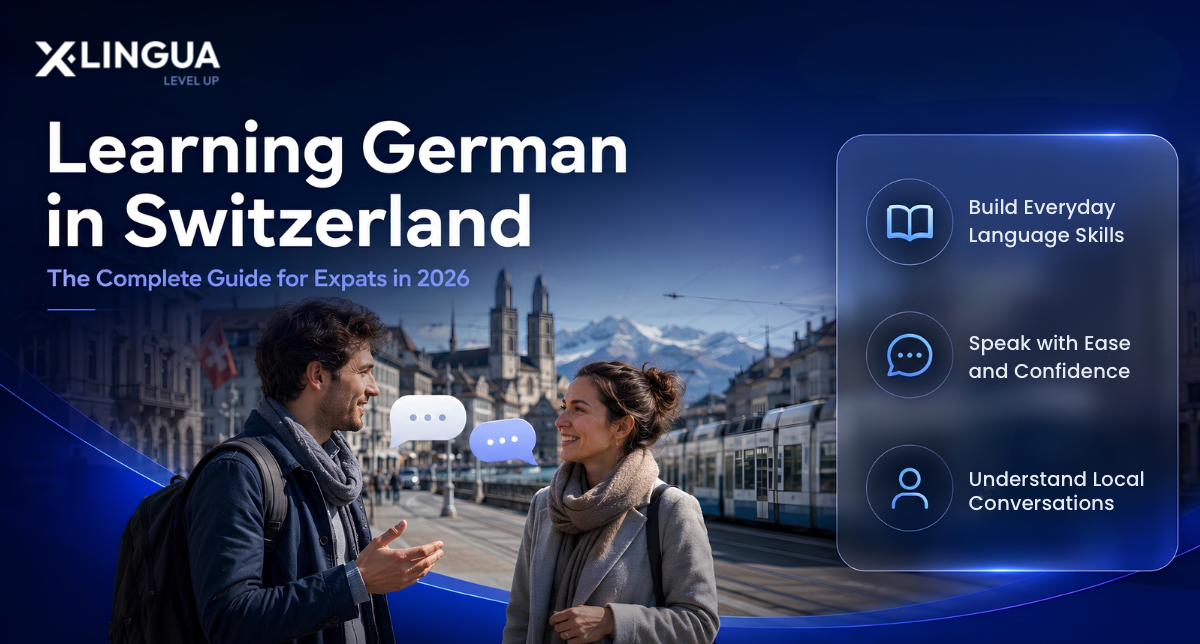
Learning German in Switzerland: The Complete Guide for Expats in 2026
Table of contents
- Why German in Switzerland Is Not One Language
- Swiss German vs High German: What Expats Need to Know
- Why Understanding German Is Not the Same as Speaking It
- German Language Requirements for Swiss Permits and Citizenship
- What the FIDE test measures
- Federal minimum language levels by procedure
- Certificates accepted alongside the FIDE test
- How long does it take to reach conversational German
- German for the Swiss workplace
- What it costs to learn German in Switzerland
- Common mistakes expats make when learning German in Switzerland
- How to start speaking with confidence
- Conclusion
- Frequently asked questions
Learning German in Switzerland means learning two languages at once: Standard German for reading, writing, and formal situations, and Swiss German for the everyday conversations that actually happen around you. Most expats reach a point where they understand far more than they can say. This guide covers the Swiss language landscape, what permits and citizenship actually require, how long progress takes, what it costs, and how to close the gap between understanding German and speaking it with confidence.
This guide is regularly reviewed for accuracy. Language requirements for permits and citizenship can change by canton, so always confirm current details with your local migration office or the State Secretariat for Migration (SEM) before submitting an application.
Why German in Switzerland Is Not One Language
Switzerland has four national languages: German, French, Italian, and Romansh. Roughly 62 per cent of the population speaks German as a main language, concentrated in the central, eastern, and northern parts of the country, while French dominates the west and Italian the south.
The complication for expats is that "German-speaking Switzerland" does not mean that people speak German as written. Standard German, known locally as Hochdeutsch, is used in writing, schools, the news, and most formal correspondence. Spoken daily life runs almost entirely on Swiss German, a family of dialects that differ from Standard German in pronunciation, vocabulary, and grammar.
This split is the single biggest source of frustration for newcomers. You can study Hochdeutsch for a year, pass a certificate exam, and still struggle to follow a conversation between two colleagues in the office kitchen. Understanding this distinction early saves months of confusion later.
Swiss German vs High German: What Expats Need to Know
Swiss German, or Schweizerdeutsch, is not a simplified or broken version of Standard German. It is a distinct set of dialects with their own sound system, idioms, and even some grammar rules that do not exist in Hochdeutsch, such as the absence of a simple past tense in most everyday speech. The two are used in different contexts, and knowing which one applies where prevents a lot of wasted study time.
| Context | Language typically used |
|---|---|
| Written communication, emails, contracts | Hochdeutsch |
| News broadcasts, official documents | Hochdeutsch |
| School instruction (written materials) | Hochdeutsch |
| Everyday conversation, small talk, family life | Swiss German |
| Meetings and workplace chat (varies by company) | Mix of both, often defaulting to Swiss German among colleagues |
| Federal language exams for permits (fide test) | Hochdeutsch, spoken and written |
There are also regional variations within Swiss German itself. Zurich German, Bernese German, and Basel German are not identical, and a word that is common in one canton can sound unfamiliar in another. This is normal, and native speakers themselves navigate these differences without much thought.
Most expats are best served by building a solid Hochdeutsch foundation first, since it is what official tests, workplace writing, and most structured courses use, and then layering in Swiss German listening and speaking skills once they are living and working in a German-speaking canton. XLINGUA's Swiss German course is built specifically for this second stage, focused on understanding dialect and joining conversations rather than starting from zero.
Why Understanding German Is Not the Same as Speaking It
Many expats reach the B1 or B2 level, pass a certificate exam, and can read a newspaper article without difficulty. Then a colleague asks a question in a meeting, and their mind goes blank. This experience is common enough to have a name in language education: the gap between comprehension and production.
The linguist Stephen Krashen described this dynamic through two ideas that remain central to how language acquisition is understood today. The input hypothesis holds that we acquire language by understanding messages slightly beyond our current level, rather than by memorising grammar rules in isolation. The affective filter hypothesis explains that anxiety, self-consciousness, and fear of making mistakes can block that input from being processed, even when a learner technically knows the material (Krashen, Principles and Practice in Second Language Acquisition, 1982).
In practice, this means a learner can have all the vocabulary and grammar they need stored away, yet freeze the moment real-time pressure is added. Grammar drills and vocabulary lists build knowledge. They do not, on their own, build the confidence and reflexes needed to speak under pressure.
XLINGUA refers to this gap as the Speaking Gap, and it is the starting point for the school's teaching approach, the XLINGUA Flow™ method, which is built around speaking from the first lesson rather than after months of preparation.
German Language Requirements for Swiss Permits and Citizenship
Language requirements affect residence permits, family reunification, and Swiss citizenship. Rules are set at the federal level but can be raised by individual cantons, so the numbers below are a starting point, not a substitute for checking your own canton's current requirements.
The information in this section is accurate as of July 2026, based on published federal guidance. Requirements can and do change. Always verify current levels with the State Secretariat for Migration or the fide portal, and confirm the specific requirement for your procedure with your cantonal or communal migration office before booking a test or submitting an application. This section is informational only and does not constitute legal or immigration advice.
What the FIDE test measures
The fide test was developed on behalf of the State Secretariat for Migration and is designed around everyday situations rather than academic German. It assesses speaking and listening separately from reading and writing and issues a FIDE Sprachenpass that shows a distinct CEFR level for each skill area. It typically costs in the range of 250 to 350 Swiss francs depending on the test center, and the results do not expire, though authorities may ask for a newer certificate if a long time has passed. XLINGUA's FIDE preparation course is built around this exact format.
Federal minimum language levels by procedure
| Procedure | Typical federal minimum | Notes |
|---|---|---|
| B permit (residence) | Varies by canton, often A1 | Confirm with your migration office |
| C permit, standard route (after 10 years) | A1 written, A2 oral | Some cantons set higher levels |
| C permit, fast-track route (after 5 years) | A1 written, B1 oral | Requires demonstrating stronger integration |
| Swiss citizenship (federal minimum) | A2 written, B1 oral | Multiple cantons require more |
Several cantons, including Schwyz, Nidwalden, Thurgau, and Zug, already require B2 oral and B1 written for naturalization, above the federal floor, and other cantons periodically raise their own thresholds. This is exactly why confirming your canton's current rule before you start studying matters more than following a generic number found online.
Certificates accepted alongside the FIDE test
Cantonal authorities generally also accept certificates from Goethe-Institut, telc, and a small number of other recognized providers, provided they appear on the official recognized list published by SEM. If you already have a certificate from one of these providers, check whether it meets your specific canton's threshold before booking an additional exam.
How long does it take to reach conversational German
Progress depends heavily on the starting point, study intensity, and the amount of real-world exposure a learner gets outside the classroom. The ranges below assume regular study, roughly one to two structured lessons per week plus some independent practice, and are meant as a general planning guide rather than a guarantee.
| CEFR level | What it typically means in practice | Approximate time from zero, with regular study |
|---|---|---|
| A1 | Basic greetings, simple personal information | 2 to 3 months |
| A2 | Everyday topics, simple past experiences | 4 to 6 months |
| B1 | Independent communication, most daily situations, work basics | 8 to 12 months |
| B2 | Confident workplace communication, complex opinions | 14 to 20 months |
| C1 | Near-fluent, nuanced professional and academic use | 20 to 30 months |
These timelines assume consistent weekly practice. Learners who live and work primarily in English or another language, with limited daily exposure to German, will progress more slowly through each stage, since real progress depends on regular comprehensible input rather than classroom hours alone.
Speaking-first formats tend to compress the early stages faster than grammar-heavy formats, because learners start producing language immediately rather than spending months absorbing rules before ever forming a sentence. XLINGUA's German course overview breaks these levels down course by course, from A1 through C2.
German for the Swiss workplace
Workplace communication in German-speaking Switzerland has its own conventions that differ from both casual conversation and textbook German. A few patterns matter more than most course materials cover.
Meetings often mix Hochdeutsch and Swiss German depending on who is present and how formal the setting is. A presentation might be delivered in Hochdeutsch, while the discussion afterward slips into dialect among colleagues who share it.
Email and written correspondence remain almost exclusively in Hochdeutsch, and tone tends to be direct and structured rather than heavily softened, which can read as blunt to newcomers used to more indirect business cultures.
Small talk before meetings, in the kitchen, or during commutes is where Swiss German is used most, and it is often where expats feel excluded even after reaching a strong level in Hochdeutsch, since casual dialect conversation moves faster and uses different vocabulary than formal German.
Being able to participate, even briefly, in this informal layer of communication has an outsized effect on how quickly a newcomer is seen as part of the team rather than a visitor. This is one reason XLINGUA's corporate training programs are built around real workplace scenarios, including meetings, informal exchanges, and industry-specific vocabulary, rather than generic business German modules.
What it costs to learn German in Switzerland
Costs vary depending on the course format, class size, learning intensity, and whether the programme is offered by a public institution, a private language school, or an employer. As a general guide, structured group courses in Switzerland typically cost between CHF 1,000 and CHF 2,000 per CEFR level, while private coaching is usually priced per session or package and comes at a higher hourly rate.
To help you compare, the table below outlines XLINGUA's current course formats and pricing.
| Format | Structure | Price |
|---|---|---|
| Single group course | 20 weeks, small group, 90 minutes weekly | CHF 1,199 |
| Two consecutive group courses | 40 weeks, priority support | CHF 1,999 |
| VIP private coaching | 10 private sessions, 1:1 or 2:1 | CHF 999 |
| Corporate training | Custom scope for teams | Quoted per company |
Exam costs are separate from course fees. The FIDE test typically runs 250 to 350 Swiss francs, and Goethe or telc exams are priced separately by their own institutes. Budgeting for both course fees and exam fees upfront avoids surprises later in the process.
Common mistakes expats make when learning German in Switzerland
A few patterns recur among newcomers, regardless of their prior language experience.
- Studying only Hochdeutsch and expecting to follow daily conversation. Hochdeutsch is essential for exams and writing, but it will not fully prepare you for spoken Swiss German at work or in social settings.
- Waiting to speak until grammar feels "ready." Production ability develops through use, not through reaching a theoretical readiness point. Waiting delays the exact practice that builds fluency.
- Choosing a course based on price alone without checking speaking time. A cheap course with minimal speaking practice can cost more in the long run through slower progress and repeated enrollments.
- Ignoring the exam format until close to test day. The FIDE test's separate oral and written scoring rewards targeted preparation for each skill, and generic conversation practice alone does not fully prepare a candidate for its specific structure.
- Underestimating canton-specific requirements. Federal minimums are a floor, not a guarantee, and several cantons require levels well above them for citizenship.
- Avoiding mistakes in conversation out of embarrassment. Error correction in the moment, within a low-pressure group, accelerates acquisition far more than silent avoidance ever does.
How to start speaking with confidence
- Closing the gap between understanding German and speaking it requires a different kind of practice than most self-study apps or grammar-first courses provide. A few principles consistently help.
- Prioritize speaking time over passive review. If a course spends most of its time on grammar explanation rather than live conversation, progress in spoken fluency will lag behind written comprehension.
- Practice in small groups rather than alone or in large classes. Small groups create enough psychological safety to make mistakes out loud, which is where real progress happens, while still providing the social pressure of a live conversation partner.
- Get corrected in the moment, not days later. Feedback that arrives immediately after a mistake is far more useful than a grade on a worksheet returned the following week.
- Build in real scenarios early. Ordering at a bakery, introducing yourself at work, or asking a doctor a question are situations worth rehearsing directly, rather than only studying abstract vocabulary lists.
This is the reasoning behind XLINGUA's German course structure: small groups of three to six learners, 70 to 80 percent speaking time in every session, and live correction from a teacher rather than delayed feedback. Learners who have tried grammar-first courses elsewhere often describe the shift to a speaking-first format as the point where German finally started to feel usable rather than theoretical.
Conclusion
Learning German in Switzerland is really two projects at once: building a solid foundation in Hochdeutsch for exams, work, and writing, and gradually picking up enough Swiss German to feel part of daily life. Neither happens through grammar study alone. The learners who progress fastest are the ones who start speaking early, get corrected in real time, and treat mistakes as part of the process rather than something to avoid.
If you recognize the gap between understanding German and actually speaking it, that gap has a name, and XLINGUA was built specifically to close it. Book a free consultation to find out which course fits your current level and your goals, whether that is everyday confidence, workplace fluency, or passing your FIDE test.
Frequently asked questions
What level of German do I need for a Swiss permit or citizenship?
Federal minimums are A1 to A2 for most residence permits and A2 written plus B1 oral for citizenship, but several cantons require higher levels. Always confirm the exact requirement with your cantonal migration office before testing.
Is Swiss German or High German more useful to learn first?
Hochdeutsch is essential for exams, writing, and formal situations, and is the recommended starting point. Swiss German listening and speaking skills are best acquired once you are living in a German-speaking canton and have a foundation in Hochdeutsch to build on.
How long does it take to reach B1 German as an expat?
With regular weekly study, most learners reach B1 in roughly eight to twelve months from a starting point of zero. Learners with more consistent real-world exposure to German often progress faster than this range.
Do I need to pass the FIDE test specifically, or are other certificates accepted?
Most cantons accept FIDE alongside recognized alternatives such as Goethe-Institut or telc certificates, provided they appear on SEM's official recognized list. Check the accepted providers for your specific canton before booking an exam.
Why do I understand German but freeze when I need to speak it?
This is a well-documented pattern in second language acquisition, driven by the gap between passive comprehension and active production, and often intensified by anxiety in the moment of speaking. Consistent low-pressure speaking practice, rather than more grammar study, is the most effective way to close it.
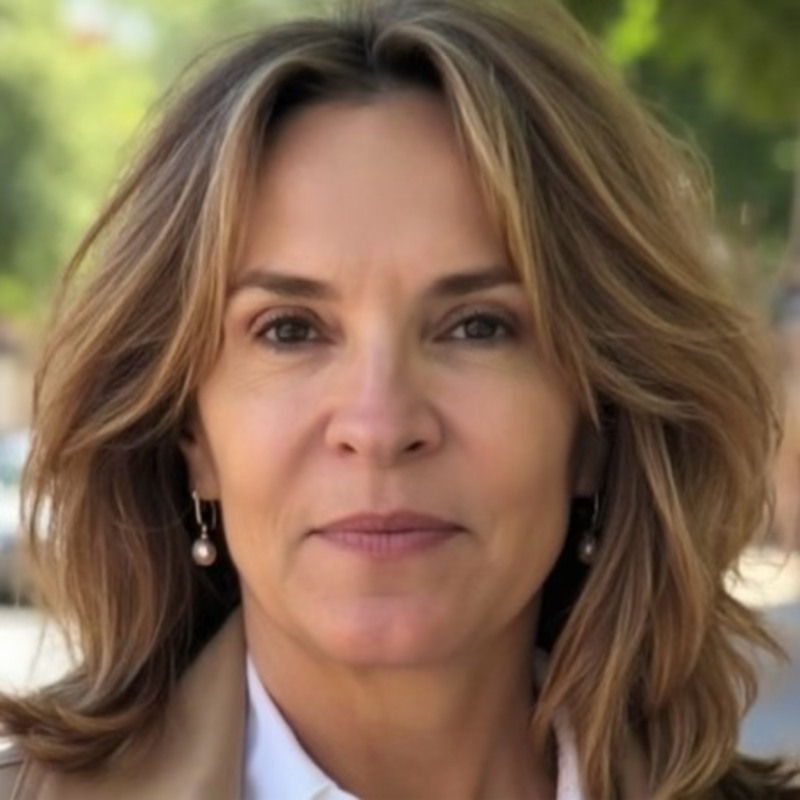
Eveline Rosa
Founder & Head of Training
Eveline Rosa is the founder of XLINGUA. As an experienced linguist and coach, she specializes in helping expats, executives, and teams quickly overcome language barriers in Switzerland and speak with confidence.