The Complete FIDE Exam Guide for Expats in Switzerland
Table of contents
- FIDE exam at a glance
- What is the FIDE exam?
- How the FIDE exam is structured
- Why oral and written levels are scored separately
- What language level do you need for your permit or citizenship?
- What to expect in the oral part
- What to expect in the written part
- FIDE exam cost and registration
- How to prepare for the FIDE exam
- FIDE vs Goethe vs TELC
- Common mistakes candidates make
- Conclusion
- Frequently asked questions
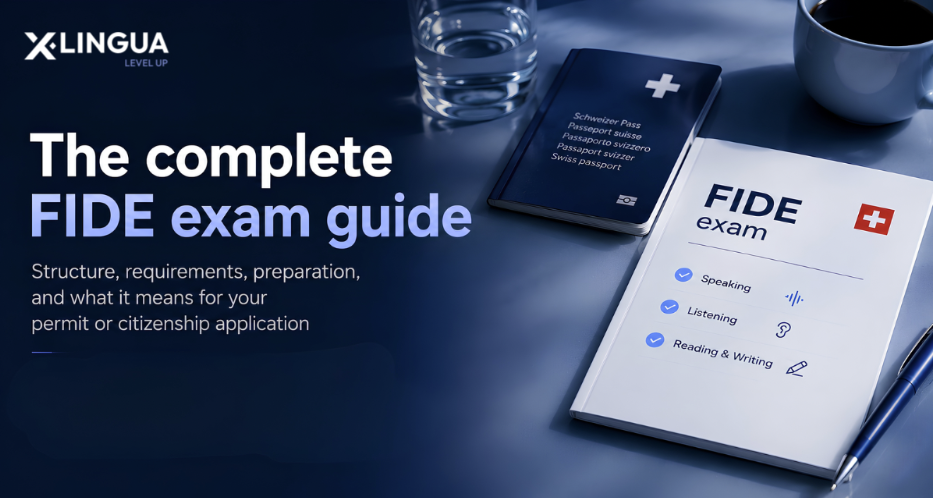
The FIDE exam, officially known as the fide test, is Switzerland's language assessment for German, French, or Italian and plays a direct role in permit renewals and naturalisation decisions. Many candidates search for it under both names, and both refer to the same official assessment run on behalf of SEM. This guide covers what the exam measures, how it is structured, what level you need for your specific procedure, what it costs, and how to prepare with a speaking-first approach.
This guide is a companion to our complete guide to learning German in Switzerland, which covers the broader landscape of Hochdeutsch and Swiss German.
FIDE exam at a glance
| What you need to know | Detail |
|---|---|
| Total exam duration | Approximately 100 minutes |
| Oral part | Approximately 40 minutes |
| Written part | Approximately 60 minutes |
| Full exam fee | CHF 250 |
| Results | Typically sent by post around 4 weeks after the test |
| Where it applies | Required or accepted for most residence permit and citizenship applications |
What is the FIDE exam?
The fide test was developed by the State Secretariat for Migration (SEM) to assess practical, everyday language use rather than academic grammar. It focuses on situations expats actually encounter, such as a doctor's appointment, a conversation with the Gemeinde, or a workplace exchange.
The exam covers three CEFR levels, A1, A2, and B1. Unlike academic exams, a candidate does not choose a level in advance. The tasks themselves determine the level achieved in each skill area, based on performance on the day. Passing the fide test results in the Swiss language passport, the official document authorities use to verify SEM language requirements for a given procedure.
How the FIDE exam is structured
The fide test has two parts, an oral part and a written part, and each can be taken together or separately depending on what a candidate's procedure requires. The full exam takes approximately 100 minutes.
| Part | What it measures | Typical duration | Format |
|---|---|---|---|
| Oral part | Speaking and listening comprehension | Approximately 40 minutes | A conversation with an examiner plus role-play tasks based on everyday situations |
| Written part | Reading and writing | Approximately 60 minutes | Practical tasks such as filling in a form, writing a short message, or understanding an administrative letter |
Why oral and written levels are scored separately
A candidate does not receive one overall grade. Instead, the result is recorded on the fide Sprachenpass, or language passport, which shows separate CEFR levels for speaking and listening, and a separate level for reading and writing. It is normal and fully accepted by authorities for a candidate to score higher in one skill area than in another.
What language level do you need for your permit or citizenship?
Federal minimums set a floor, but individual cantons are free to set higher thresholds, particularly for naturalisation. The table below reflects commonly cited federal minimums as of 2026 and should be treated as a starting point rather than a final answer for any specific application.
| Procedure | Typical federal minimum | Notes |
|---|---|---|
| B permit (residence) | Often A1, varies by canton | Confirm with your migration office |
| C permit, standard route | A1 written, A2 oral | Some cantons set higher levels |
| C permit, fast-track route | A1 written, B1 oral | Requires demonstrating stronger integration |
| Swiss citizenship | A2 written, B1 oral | Several cantons require more |
Cantons such as Schwyz, Nidwalden, Thurgau, and Zug have set naturalisation thresholds above the federal floor. This is exactly why confirming the current requirement with your own canton, before you commit to a study plan, matters more than following a generic number found online.
What to expect in the oral part
The oral part is designed to adapt to a candidate's actual living situation in Switzerland. An examiner may ask about shared spaces in an apartment building, or about a garden if the candidate lives in a house, so the scenario reflects real life rather than a generic script.
Typical tasks include describing an everyday scene, taking part in a short role-play, such as rescheduling an appointment, and discussing personal circumstances, such as housing, work, or family. There is no multiple-choice format and no isolated grammar testing.
What to expect in the written part
The written part focuses on tasks a resident is likely to face directly, such as completing a form, writing a short message to a landlord or colleague, or reading and understanding a letter from an official authority. As with the oral part, the emphasis is on practical comprehension rather than academic composition.
FIDE exam cost and registration
According to fide-service.ch, the official registration body, standard fees as of 2026 are set nationally, though candidates should always confirm the exact amount with their chosen accredited test centre before booking.
| Test option | Typical fee (CHF) |
|---|---|
| Full test (oral and written) | 250 |
| Oral part only | 170 |
| Written part only | 120 |
- Find an accredited test centre through fide-service.ch, which lists all authorised institutions across Switzerland.
- Register at least 15 days before your chosen test date and confirm whether you need the oral or written part, or both.
- Attend the exam in person. The fide test cannot be completed online.
- Results and the language passport are typically sent by post approximately 4 weeks after the test, or up to 6 weeks for tests taken between mid-December and mid-January.
How to prepare for the FIDE exam
Because the fide test is built around real conversation and practical writing rather than grammar recall, the most effective preparation mirrors the exam itself. Passive grammar review has limited value here compared with active speaking practice under light time pressure.
- Practice describing everyday scenes out loud rather than only reviewing vocabulary lists.
- Rehearse short role-plays, such as cancelling an appointment or asking a question at the Gemeinde.
- Review the official mock test available on fide-service.ch to understand the exact task format before test day.
- Practice filling in simple forms and writing short messages, since the written part rewards clarity over complexity.
- Get comfortable speaking with some hesitation. Examiners assess practical communication, not grammatical perfection.
"What I lacked wasn't vocabulary, it was confidence. After only a few weeks with XLINGUA, I was holding real conversations and finally feeling connected to the world around me." — XLINGUA student (UK expat in Switzerland for 19 years)
Their experience reflects the same shift the FIDE exam rewards: moving from passive understanding to active, confident speaking.
This is what XLINGUA's Flow™ method is built around, since 70 to 80 per cent of every session is spent speaking rather than completing grammar exercises alone. Learners preparing specifically for this exam can start with XLINGUA's FIDE preparation course, which is structured around the exam's actual oral and written formats.
FIDE vs Goethe vs TELC
Candidates outside the fide system sometimes hold, or consider, a Goethe or TELC certificate instead. All three are accepted for at least some Swiss procedures, but they are built for different purposes.
| Exam | Focus | Best suited for |
|---|---|---|
| FIDE | Practical, everyday Swiss situations | Candidates whose main goal is a Swiss permit or naturalisation, with no international use needed |
| Goethe-Institut | Academic and internationally recognised German | Candidates who also need a certificate for university admission or international employers |
| TELC | Structured, internationally recognised German | Candidates who want a certificate accepted both in Switzerland and abroad |
The fide test is generally shorter and more focused on Swiss administrative and social contexts than the Goethe or TELC tests, which assess broader academic German. Most cantons accept the FIDE certificate alongside Goethe or TELC certificates that appear on SEM's officially recognised list, so the right choice depends on whether you need the certificate to travel with you outside Switzerland.
Common mistakes candidates make
- Assuming the federal minimum applies to their canton without checking the current local requirement.
- Preparing only with grammar-heavy materials that do not reflect the exam's practical, scenario-based format.
- Registering close to a target deadline, since some test centres have limited slots and appointments can fill up weeks in advance.
- Skipping the official mock test, which is the clearest way to understand what the examiners are actually looking for.
- Treating the oral and written parts as equally weighted when a specific procedure requires only one.
Conclusion
The fide exam is not an academic hurdle. It is a practical check on whether a candidate can manage daily life in Switzerland, and understanding its format in advance removes most of the uncertainty. Federal minimums are a starting point, so confirming the exact requirement for your canton and procedure remains the essential first step.
Not sure which FIDE level you need for your permit or citizenship application? Contact us, and we'll help you determine the correct requirement before you register.
Frequently asked questions
What level of German do I need for Swiss citizenship?
The federal minimum for naturalisation is commonly cited as A2 in writing and B1 in speaking, but several cantons require higher levels. Confirm the exact figure with your cantonal migration office before booking a test.
How much does the FIDE exam cost?
As of 2026, the standard fee is CHF 250 for the full test, CHF 170 for the oral part alone, and CHF 120 for the written part alone, though candidates should confirm the exact amount with their chosen test centre.
How long does it take to receive FIDE exam results?
Results and the language passport are typically sent by post around 4 weeks after the test date, with the timing extending to roughly 6 weeks for tests taken between mid-December and mid-January.
Can I take only the oral or only the written part?
Yes. Candidates can register for the full exam or for just the oral or written part, depending on what their specific permit or citizenship procedure requires.
Is Swiss German accepted in the oral part?
Swiss German dialect is accepted during the oral part of the German-language fide exam, since it is designed around real spoken situations rather than strict Hochdeutsch delivery.
How is the FIDE exam different from the Goethe or the TELC?
The fide test focuses on everyday, Swiss-specific situations and is generally shorter than Goethe or TELC exams, which are more academic and internationally recognised. Most cantons accept fide alongside Goethe or TELC certificates that appear on SEM's officially recognised list.
How do I prepare for the FIDE exam?
The most effective preparation focuses on speaking practice and the official mock test rather than grammar review, since the exam rewards practical communication over accuracy. XLINGUA's Flow™ method is built around this exact approach, with 70 to 80 per cent of every session spent speaking.
Eveline Rosa
Founder & Head of Training
Eveline Rosa is the founder of XLINGUA. As an experienced linguist and coach, she specializes in helping expats, executives, and teams quickly overcome language barriers in Switzerland and speak with confidence.