 Language Learning
Why You Freeze When Speaking a Language You Already Know
Table of contents
- What a language level actually measures
- Retrieval speed: Knowing a word and finding it in time
- Cognitive load: Why everything competes for attention
- Interruptions and fast turn-taking
- Spontaneous production: Speaking without a script
- What helps you speak better under pressure
- How XLINGUA trains real-time speaking
- Conclusion
- Frequently asked questions
You passed the B1 test, or maybe B2. The certificate might already be on file for work or a permit application.
Then your manager asks for your view in a team meeting, or a client asks an unexpected question on a call, and your level seems to drop by a whole band.
That experience is common, and it doesn't mean your certificate was wrong. A formal language level and the ability to speak in real time are related, but they're often tested under very different conditions.
This guide explains what changes when a conversation goes live, and what actually helps. It applies whether you're speaking German, Swiss German, French, English, Italian or Spanish.
What a language level actually measures
Most European language levels are based on the Common European Framework of Reference for Languages, or CEFR. It's a useful, widely recognised scale from A1 to C2.
Many people don't realise that the CEFR doesn't describe a single skill. The CEFR Companion Volume, published by the Council of Europe in 2020, includes separate scales for spoken production, spoken interaction, turn-taking, and spoken fluency, among others.
So a single overall level is a summary. Your reading or listening may sit at B2, while your ability to take the floor in a fast discussion sits lower.
Exams and level tests also need to be fair and comparable. That's why they tend to use structured tasks and clear instructions. Real conversations rarely work that way.
| Structured test or class | Live conversation |
|---|---|
| Clear instructions and a known format | No warning about what comes next |
| Time to think before answering | A response is expected almost instantly |
| One person speaks at a time | People interrupt, overlap and change topic |
| Familiar, predictable topics | Anything can come up |
| Calm, controlled setting | Social pressure and real consequences |
Retrieval speed: Knowing a word and finding it in time
Conversation moves much faster than most people realise. A 2009 PNAS study of turn-taking across 10 languages found that speakers in every language tested avoid overlapping talk and keep the silence between turns to a minimum.
A review by Levinson and Torreira puts the typical gap between turns at around 200 milliseconds. Yet producing even a single new word takes around 600 milliseconds or more.
The researchers explain that people must plan their reply while the other person is still talking. In your first language, that happens without effort.
In a second language, retrieving words and grammar usually takes longer. By the time your sentence is ready, the moment has often passed. For example, imagine a project manager in Zurich with a solid B2 level in German. In a team meeting, her manager asks, "Was meinst du dazu?" She knows her answer, but while she's still choosing the verb, a colleague replies first. An hour later, she makes the same point in a clear, well-written email.
We have explored this further in the science behind the Speaking Gap™. Check it out.
Cognitive load: Why everything competes for attention
Speaking involves several steps at once. You decide what to say, find the words, build the sentence, pronounce it and check for mistakes, all while still listening.
A widely used model of second-language speech, developed by Judit Kormos, suggests that in a second language, building sentences and pronouncing them are less automatic. They require more conscious attention, so the steps tend to run one after another rather than in parallel.
That helps explain why your speaking can fall apart when you're also processing a fast question, an unfamiliar accent or a tense meeting. The language hasn't disappeared. Your attention is simply spread across too many tasks at once.
Stress may add to this. Stephen Krashen's affective filter hypothesis proposes that anxiety can make language harder to access. It remains a hypothesis rather than a proven mechanism, but it matches what many learners describe.
Interruptions and fast turn-taking
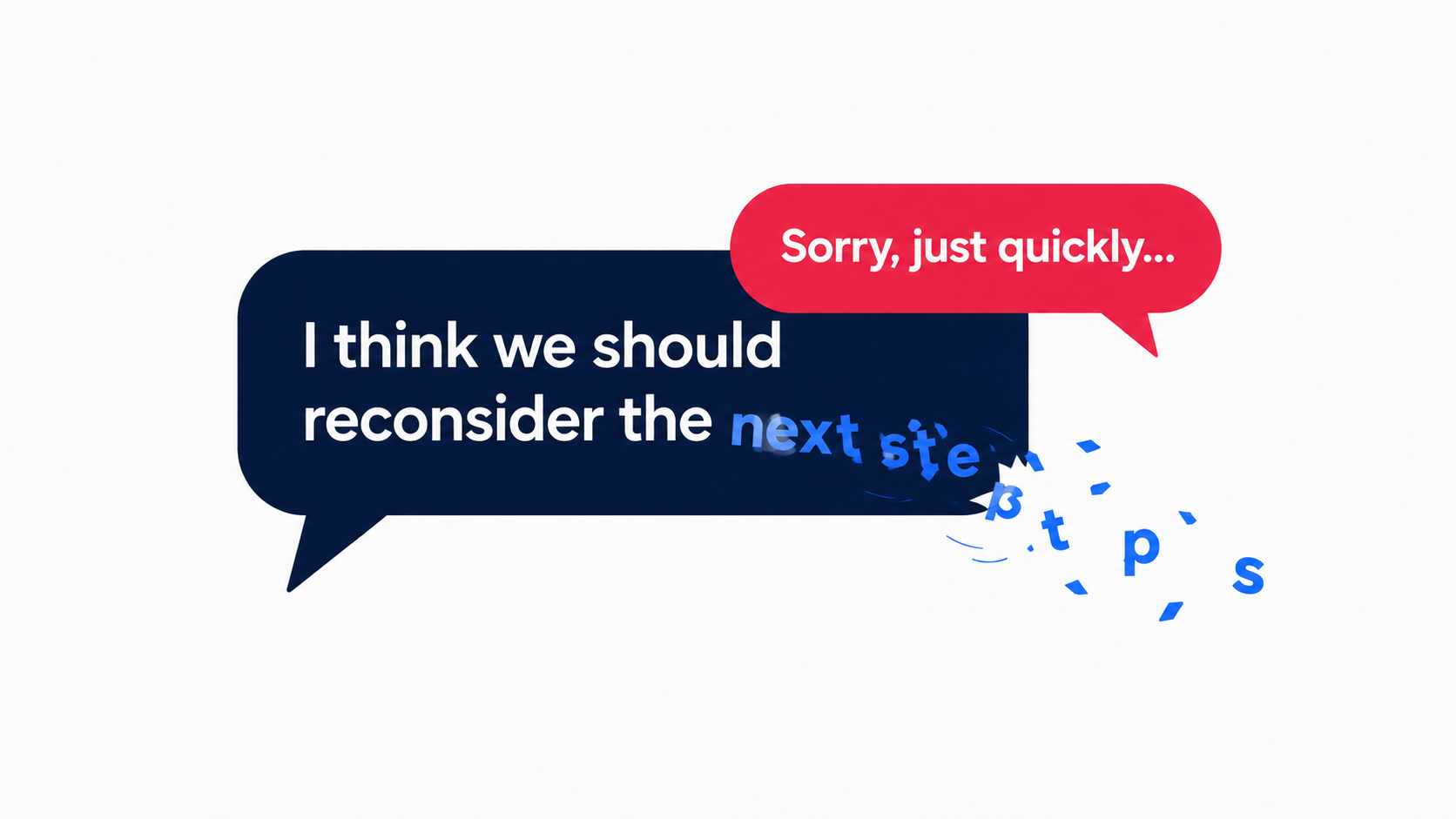
One-to-one conversations are demanding. Group conversations are harder.
In a meeting, several people may want to speak at once, and the floor often goes to whoever responds first. Research on group conversations suggests this competition can speed up response times even more.
Interruptions add another layer. When someone cuts in, you lose the sentence you were building and have to restart while the topic keeps moving.
Taking the floor is a skill in its own right, which is why the CEFR describes turn-taking on a separate scale. For teams, we've written about how this shows up at work in Your employees don't need another language course. They need to speak in meetings.
What this looks like at work
At work, these moments are rarely neutral. They often shape how colleagues see your expertise.
Common situations include:
- Being asked for your opinion halfway through a fast discussion.
- Disagreeing with a point before the meeting moves on.
- Answering a client's follow-up question without notice.
- Presenting an update when questions start before you've finished.
When speaking feels slow in these moments, many professionals hold back. They may know the answer and have the experience, but the contribution never reaches the room. Over time, that can affect how visible and confident they feel at work, even when their technical skills are strong.
Spontaneous production: Speaking without a script
Planned speaking, such as a rehearsed presentation, lets you prepare the language in advance. Spontaneous speaking doesn't.
When a colleague asks what you think, or a neighbour starts a conversation in the stairwell, you have to build your answer from scratch, in real time, with no idea what comes next.
Formal levels and structured lessons often train this skill the least, but it matters most in daily life.
What helps you speak better under pressure
You can't slow down a conversation, but you can make the language easier to access when you need it.
- Learn useful phrases as complete chunks. Fluency research suggests that ready-made language chunks support smoother speech because you don't have to build them word by word.
- Start with a short answer, then expand. A quick "I agree, because…" gets you into the conversation before the moment passes.
- Use phrases that buy you time, ask for clarification or let you rephrase. These keep you in the conversation while you think.
- Rephrase instead of searching for the perfect word. If the exact word won't come, describe it another way and keep going.
- Practise short, unscripted exchanges regularly. Speed comes from repeated real attempts, not from more preparation.
These phrases are a good place to start in German and French:
| Purpose | German | French |
|---|---|---|
| Hold the floor | "Moment, ich will das noch sagen." | "Attendez, j'aimerais ajouter quelque chose." |
| Ask for clarification | "Können Sie das bitte anders sagen?" | "Vous pouvez reformuler, s'il vous plaît ?" |
| Buy thinking time | "Wie soll ich sagen…" | "Comment dire…" |
| Rephrase | "Ich meine…" | "Je veux dire…" |
| Disagree politely in a meeting | "Ich sehe das etwas anders." | "Je vois les choses un peu différemment." |
The same strategies work in English, Italian, Spanish and Swiss German. Only the words change.
How XLINGUA trains real-time speaking
Speaking under pressure is a skill, and it improves the same way other skills do, through regular practice in conditions close to the real thing.
That's the idea behind XLINGUA Flow™, our speaking-first method. It works because it combines four elements, each aimed at a challenge described in this article.
| The challenge | How XLINGUA trains it |
|---|---|
| Too few chances to speak in class | Small groups of three to six people, so everyone speaks often. |
| Slow retrieval under time pressure | 70 to 80 per cent of each lesson is spent speaking, so you retrieve language faster with practice. |
| No script in real conversations | Spontaneous, unscripted conversation, so you practise responding without knowing what comes next. |
| Mistakes that go unnoticed or repeat | Immediate feedback from a certified teacher, so corrections happen in the moment, while they still matter. |
Each element helps on its own. Together, they recreate the conditions of a real conversation in a setting where it's safe to stumble, try again and improve.
For companies, XLINGUA also offers team courses and executive coaching built around the situations employees face at work, such as meetings, client calls and presentations. Each programme starts with a needs analysis, and HR receives regular progress reports. Learn more about our corporate language training.
Conclusion
If your language level feels different in real conversations, there's a clear reason. Live conversation asks you to retrieve language in fractions of a second, manage several mental tasks at once, handle interruptions and speak without a script.
A formal level shows what you know. Real-time speaking shows how quickly and confidently you can use it. The good news is that you can train this second skill, and it improves with regular, low-pressure practice.
Experience speaking-first learning for yourself
The best way to understand the difference is to feel it. In a small group, with a teacher guiding you and most of the lesson spent speaking, you'll notice how quickly real conversation starts to feel more natural.
Book a free consultation to talk through your goals with the XLINGUA team and learn how speaking-first training can work for you or your team.
Frequently asked questions
1. If I have a B2 certificate, why can't I speak at B2 in meetings?
An overall level summarises several skills, and they don't always develop at the same pace. Meetings also add speed, interruptions and pressure that most tests and classes don't reproduce.
2. Why can I speak well some days and freeze on others?
Speaking depends on how much attention you have available. Tiredness, stress, a fast speaker or an unfamiliar topic all increase the load, so the same person can perform very differently in different situations.
3. Does this apply to every language?
Yes. Fast turn-taking has been observed across many languages, and the extra effort of speaking a second language isn't specific to German or French. The same strategies help in any language.
4. How long does it take to speak more quickly in real conversations?
There's no fixed timeline, because it depends on your level, your goals and how often you practise. Regular, short speaking practice usually helps more than occasional long study sessions.
5. Can I prepare for this before an important meeting or exam?
You can prepare the topic, but you can't script a live conversation. The best preparation is practising clarifying, holding the floor and rephrasing, so those phrases come automatically when you need them.
6. Can companies help employees speak more confidently in meetings?
Yes. Training works best when it focuses on real workplace situations, such as meetings, client calls and presentations, rather than general language skills alone. Small groups with plenty of speaking time help employees practise the moments that matter most at work.

Eveline Rosa
Founder & Head of Training
Eveline Rosa is the founder of XLINGUA. As an experienced linguist and coach, she specializes in helping expats, executives, and teams quickly overcome language barriers in Switzerland and speak with confidence.