Babbel Live is ending for individuals: What it means for your company's language training strategy
Table of contents
- What actually changed with Babbel Live
- Why it matters even if you never used Babbel
- What HR and L&D should be checking right now
- How to evaluate a corporate language training provider
- Live instruction vs app-only and AI-driven learning
- Why Switzerland needs a different approach
- How XLINGUA supports companies
- Conclusion
- Frequently asked questions
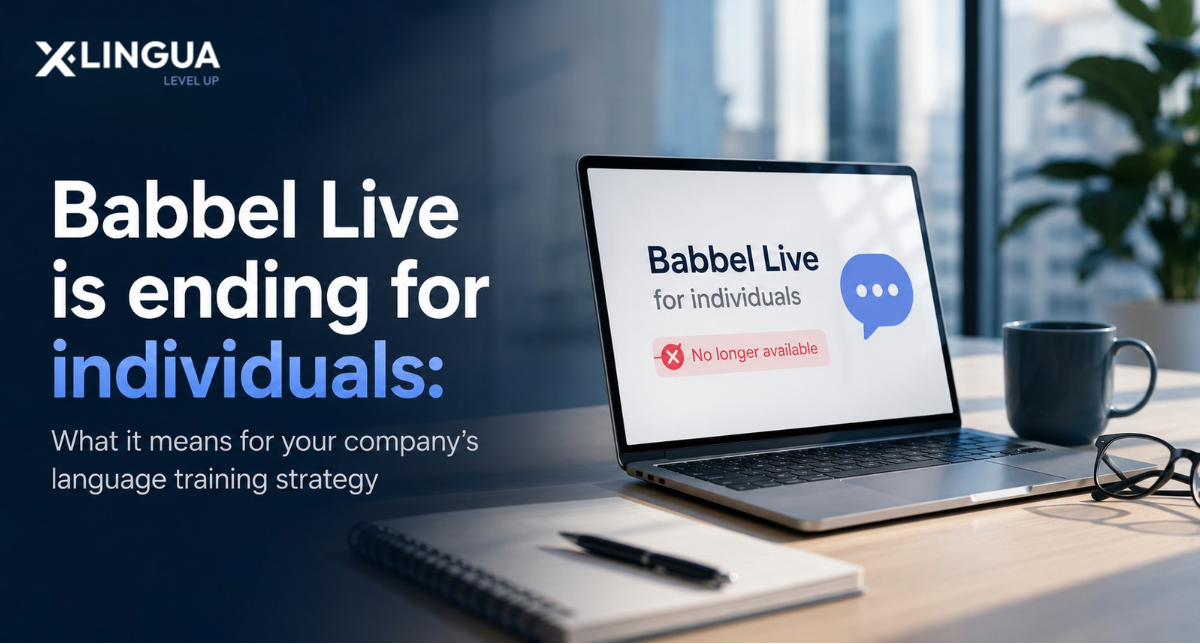
Babbel pulled the plug on Babbel Live for individual subscribers. According to Babbel, most personal users just weren't showing up to live classes often enough to make the format pay for itself, so the company pushed individuals toward the self-study app and a newer AI conversation tool instead. Live classes didn't disappear, though; they just moved. They're still there, tucked inside Babbel for Business now.
This piece walks through what actually happened, why it's worth knowing even if your company never touched Babbel, and what it should nudge HR and L&D teams to check about their own language training setup.
What actually changed with Babbel Live
Babbel Live let individual subscribers bolt small-group, instructor-led classes onto the regular self-study app. Babbel cut that option for individuals, citing low regular usage and the difficulty of running live classes profitably at consumer subscription prices.
Individual users got funnelled toward the core app and, not long after, an AI-powered conversation feature that walks learners through scripted scenarios rather than open live practice with a real instructor.
Babbel for Business wasn't touched by any of this. Corporate clients still get live, instructor-led classes as part of their subscription. Worth being clear on that, because a lot of the chatter around this change has blurred "Babbel Live is ending" with "Babbel is ending live classes," and those are different claims.
| What changed | What didn't |
|---|---|
| Individual Babbel Live subscriptions cut (July 2025) | Babbel for Business live classes still running |
| Individuals pushed toward app + AI conversation practice | Core self-study app still available to individuals |
| Some Babbel Live instructors lost that work | Babbel as a company still runs both product lines |
Why it matters even if you never used Babbel
On its own, this is just one company's product call. Two things make it worth a wider look.
First, some employees were paying for Babbel Live themselves, using it as informal language support alongside their job. That demand doesn't just disappear when the option does. It tends to show up later as an unspoken expectation that the employer will cover the gap, especially at international companies where language skills actually affect the work.
Second, Babbel's reasoning is part of a bigger pattern. As AI conversation tools get better and cheaper to run, plenty of providers are quietly shifting their consumer products away from live human instruction and toward app or AI formats. Fine for a casual individual learner. A much bigger trade-off for a company trying to get an actual team speaking confidently, and widening the Speaking Gap™ rather than closing it.
Neither point means you should switch providers. It just means this is a decent moment to check what you're actually paying for.
What HR and L&D should be checking right now
Two things follow from all this:
First: Does your company have structured language training in place at all, and if not, are employees who used to lean on tools like Babbel Live now going without something they were quietly relying on? Worth asking managers directly or running a quick internal check rather than guessing.
Second: If you already work with a provider, this is a fair time to confirm a few things. Is live instruction still a core part of what you're paying for, or has it become optional? Have class sizes and instructor access stayed the same over time? And based on what the provider is actually building right now, not just what they say in their marketing, does their roadmap point toward more human instruction or less?
A provider leaning more on automation isn't automatically bad. It's only a problem if live speaking practice, the one thing apps still struggle to replace, gets quietly trimmed and nobody on the buying side notices.
How to evaluate a corporate language training provider
Worth looking past the sales deck and checking a few concrete things, regardless of which provider you're evaluating.
| What to check | Why it matters |
|---|---|
| Live speaking practice | Apps and AI handle vocabulary and grammar recognition fine. Real speaking fluency under real conditions still needs a live conversation with someone correcting you in the moment. |
| Small-group or 1:1 formats | Big classes mean less speaking time per person. Small groups keep speaking time high while still giving you a real conversation partner. |
| Measurable progress | CEFR-aligned levels and clear reporting let HR actually track outcomes across a team, not just attendance. |
| HR reporting | Usable summaries, not just individual certificates, make renewal and budget decisions a lot easier. |
| Flexibility | Scheduling around meetings and shift patterns matters more for working adults than for a hobbyist learner. |
| Onboarding support | New international hires often need help from week one, not after some standard three-month wait. |
| Scalability | A provider should handle one new hire or a whole department without the class quality dropping. |
| Human coaching alongside tech | Self-study tools are genuinely useful between sessions, but work best backing up live instruction, not replacing it. |
None of this means a provider is bad just because it also offers app-based tools. What matters is whether live, human-led practice is still a real, consistently delivered part of the programme, or whether it's been reduced to a bullet point on the sales page while the actual product quietly shifted toward self-study.
Live instruction vs app-only and AI-driven learning
Both formats have their place. The more useful question isn't which one wins; it's what each one is actually good for.
| Format | Good for | Not so good for |
|---|---|---|
| App-based self-study | Building vocabulary, recognising grammar, flexible solo practice whenever | Real speaking confidence, handling unscripted conversation, in-the-moment correction |
| AI conversation practice | Low-pressure rehearsal of scripted scenarios, available any time | Genuinely unpredictable conversation, workplace nuance, actual accountability |
| Live human instruction | Speaking fluency under real conditions, immediate correction, workplace-specific scenarios | Convenience, compared to an app that's always on |
If you're trying to get an international hire comfortable leading a meeting in German, or a relocating employee confident enough to handle a conversation with a landlord, app and AI tools can serve as a supplement. On the evidence so far, they're not a replacement for live practice with someone who can actually adapt to the person in front of them.
Why Switzerland needs a different approach
Corporate language training in Switzerland has a few requirements that generic international providers often overlook.
Hochdeutsch is what shows up in writing and formal settings, but everyday spoken life in German-speaking Switzerland runs mostly on Swiss German dialects. An employee can reach a strong level in Hochdeutsch through a standard course and still struggle to follow a casual conversation in the office kitchen. We go into this more in our complete guide to learning German in Switzerland.
Swiss workplaces are also often multilingual by nature, spanning German, French, Italian, and English depending on the region, the client base, or the company itself. International hires relocating for work usually need language support from day one, not after a fixed enrolment window, and that support needs to cover workplace culture, such as Swiss directness, as well as grammar.
| Swiss workplace reality | What generic providers tend to miss |
|---|---|
| Hochdeutsch and Swiss German both used daily | Courses built entirely around Hochdeutsch, no dialect exposure |
| Multilingual teams (German, French, Italian, English) | One curriculum for everyone, no adjustment for canton or industry |
| International hires arriving mid-year on tight timelines | Fixed enrolment windows that delay support |
| Direct, structured Swiss communication style | Generic "business English" modules with no cultural context |
A provider built primarily for a broad international audience often isn't well-suited to handle these specifics. This is exactly the gap XLINGUA is built to close: a Switzerland-focused, speaking-first partner that pairs the XLINGUA Flow™ method with live, human-led instruction, so international professionals learn to communicate confidently at work, not just on paper. See how XLINGUA's corporate programmes work for teams.
How XLINGUA supports companies
Most language providers optimise for course completion. We optimise for speaking confidence. That distinction is the reason XLINGUA exists: a Switzerland-based language school built specifically to close the Speaking Gap™ referenced throughout this article, rather than a generic international curriculum retrofitted for the Swiss market.
The pattern holds up at scale. Across more than 500 documented success stories, and a 5.0-star average rating on both Trustpilot and Google, students consistently report the same shift: speaking for 70 to 80 per cent of every lesson, taught live by one of more than 50 certified teachers across six languages.
“Every app can teach you the words. What we built XLINGUA to teach is the courage to say them out loud.” — Eveline Rosa, Founder & CEO, XLINGUA
For companies, that means live, small-group, or one-on-one instruction built around real Swiss workplace scenarios: meetings that mix Hochdeutsch and Swiss German, onboarding conversations for a newly relocated employee, and industry-specific vocabulary rather than generic business modules. Corporate programmes are scoped per company and can combine live instruction with structured self-study material rather than relying on either alone.
You don't need to rip out an existing provider to get value from this. For most HR and L&D teams, the more useful first step is to assess what your current programme delivers and be honest about whether it still closes the Speaking Gap™ for your people, or just manages around it.
Conclusion
Babbel Live's individual ending doesn't affect companies already on Babbel for Business, and that's not the point of this article. What it points to is a bigger shift already happening in language learning, and it gives you a reasonable excuse to check whether your own provider's roadmap still puts live, human-led speaking practice ahead of app-only convenience.
Not sure whether your current language training programme still covers what your team actually needs? Contact XLINGUA, and we'll walk through your current setup and flag any gaps.
Frequently asked questions
Is Babbel for Business also being discontinued?
No. Babbel for Business remains unaffected and continues to offer live classes to corporate clients. Only Babbel Live for individual subscribers was discontinued, as of July 1, 2025.
Why did Babbel discontinue Babbel Live for individuals?
Babbel said most individual learners weren't using live classes regularly enough to keep the format financially sustainable, and shifted individual users toward self-study and AI-assisted conversation practice instead.
What should HR do if employees relied on personal Babbel Live subscriptions?
Worth checking with managers or running a quick internal survey to see if employees, especially in customer-facing or cross-team roles, have lost an informal language support option they were counting on.
What should we look for in a corporate language training provider?
Live speaking practice, small-group or 1:1 formats, measurable CEFR-aligned progress, usable HR reporting, and scheduling flexibility. These matter regardless of which provider you're looking at.
Are AI language tools a replacement for live instruction?
Not really, at least not yet. They're good for scripted, low-pressure rehearsal, but they don't match the real-time adaptability and correction you get from a live instructor, especially for workplace fluency and unscripted conversation.
Why does Switzerland need a different approach to corporate language training?
Swiss workplaces mix Hochdeutsch and Swiss German, are often multilingual, and frequently need onboarding support for relocating international staff. Generic international providers don't always plan for that.

Eveline Rosa
Founder & Head of Training
Eveline Rosa is the founder of XLINGUA. As an experienced linguist and coach, she specializes in helping expats, executives, and teams quickly overcome language barriers in Switzerland and speak with confidence.