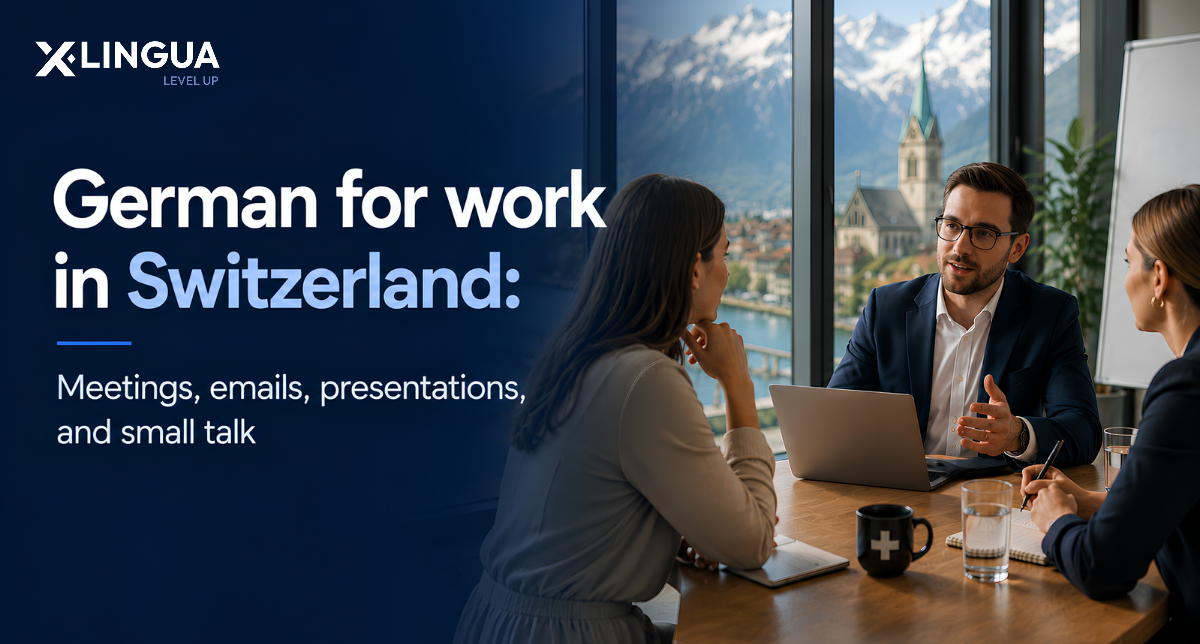
German for work in Switzerland: Meetings, emails, presentations, and small talk
Inhalt
- Why workplace German is its own skill
- Email and written communication
- Meetings: what actually gets said
- Presentations: structure over polish
- Small talk and networking: where dialect creeps in
- Phrases for the moments that actually cause the Speaking Gap™
- Common mistakes professionals make
- How XLINGUA supports this
- Conclusion
- Frequently asked questions
Passing a German course and functioning in a German-speaking office are two different things. Course German gets you through structured exercises. Workplace German has to survive an email your boss actually reads, a meeting where people talk over each other, and a coffee break where the register shifts without warning. This guide walks through what changes in each of those situations and what actually helps.
Why workplace German is its own skill
Textbook German teaches vocabulary and grammar in a vacuum. A Swiss workplace adds a variable no textbook covers: which language is actually being spoken changes depending on the company, the team, the canton, the industry, and who's in the room.
Standard German covers written communication, presentations, and many formal or mixed-language settings. Swiss German is common in everyday internal conversation between Swiss German-speaking colleagues. English is increasingly common in international companies and multinational teams. None of these is fixed. All three can show up in the same workday, sometimes the same meeting.
The real workplace skill isn't simply knowing German. It's learning to communicate confidently when the linguistic environment changes around you, without warning and without a script. That's the Speaking Gap™ in its most practical form: not a classroom problem, but a live one.
Our complete guide to learning German in Switzerland covers the Standard German and Swiss German split in more depth. This guide stays focused on the practical side: what actually happens in an email, a meeting, a presentation, or a hallway conversation, and how to hold your own when the register shifts.
Email and written communication
Written business communication in German-speaking Switzerland generally uses Standard German. Tone tends to be direct and less padded than what a lot of newcomers are used to, though this varies by company and industry. A request doesn't always need several sentences of cushioning before it, and adding them can sometimes read as unclear rather than polite.
A typical structure looks like this.
- Greeting: "Guten Tag Herr/Frau [Name]" for anything formal, "Hallo [Name]" once a working relationship is established.
- The point, early: state the request or update in the first one or two sentences, not buried at the end.
- Closing: "Freundliche Grüsse" is one of the most common sign-offs in Swiss business correspondence.
One spelling note worth flagging: Swiss Standard German uses "ss" rather than "ß", so words like "Straße" become "Strasse" in Swiss writing. This is a Standard German spelling convention, not a feature of Swiss German dialect itself, which has no single standardised written form to begin with.
The most common mistake isn't grammar. It's over-softening a direct request until the actual ask gets lost.
Meetings: what actually gets said
The language a meeting runs in depends heavily on who's in the room. Mixed groups, external attendees, or formal presentations tend to lean toward Standard German. Internal meetings among Swiss German-speaking colleagues can just as easily happen entirely in Swiss German.
A few phrases come up constantly regardless of which register the room settles into.
| Situation | Phrase | English |
|---|---|---|
| Opening a meeting | "Fangen wir an" | Let's get started |
| Asking for clarification | "Können Sie das genauer erklären?" | Could you explain that in more detail? |
| Disagreeing politely | "Ich sehe das etwas anders" | I see it a bit differently |
| Moving the discussion along | "Kommen wir zum nächsten Punkt" | Let's move to the next point |
| Confirming next steps | "Wer übernimmt das?" | Who's taking that on? |
What trips people up isn't usually the vocabulary. It's the tendency toward concise, matter-of-fact communication in a lot of Swiss professional settings. Disagreement is often stated plainly rather than heavily qualified, though this varies considerably by organisation and industry, and some are just as likely to be formal and diplomatic. It isn't personal where it does show up. It's a register, not a universal rule.
Presentations: structure over polish
Swiss audiences generally respond better to a clearly structured presentation delivered in average German than a smooth one that wanders. A simple, predictable structure covers most of the ground.
- State what you'll cover, briefly, at the start.
- Move through points in a clear order, one per slide or section.
- Summarise at the end, even if it repeats what you already said.
Q&A afterwards is usually where things get harder, since it's less scripted and more likely to shift toward faster, less formal German depending on who's asking. Preparing a few standard clarifying phrases in advance, such as "Könnten Sie die Frage wiederholen?" (could you repeat the question?), takes real pressure off in the moment.
Small talk and networking: where dialect creeps in
This is the part most course German doesn't prepare anyone for. Formal work, emails, presentations, and structured meetings tend to lean Standard German. Informal exchanges, a coffee break, or a hallway conversation, can shift into Swiss German, sometimes quickly and regionally, depending on who's talking.
Nobody expects fluency here. But recognising a common phrase or two changes how included someone feels almost immediately.
| Swiss German | Meaning |
|---|---|
| Wie gaht's? | How's it going? |
| Bis spöter | See you later |
| Merci vielmal | Thanks a lot |
Networking events don't follow one fixed pattern. Depending on who's speaking, small talk might open in Swiss German, Standard German, or English, and shift again once the conversation gets specific. There's no single rule here worth memorising. What helps more is recognising a phrase or two in each register, rather than expecting one language to carry the whole conversation.
Phrases for the moments that actually cause the Speaking Gap™
These aren't generic vocabulary. They're for the specific moments international professionals report freezing in most: needing a second to think, checking they understood correctly, jumping into a fast-moving discussion, or navigating a sudden dialect switch.
| Situation | Phrase | English |
|---|---|---|
| Buying time | "Lassen Sie mich kurz überlegen." | Let me think about that for a moment. |
| Checking understanding | "Habe ich Sie richtig verstanden, dass …?" | Have I understood correctly that…? |
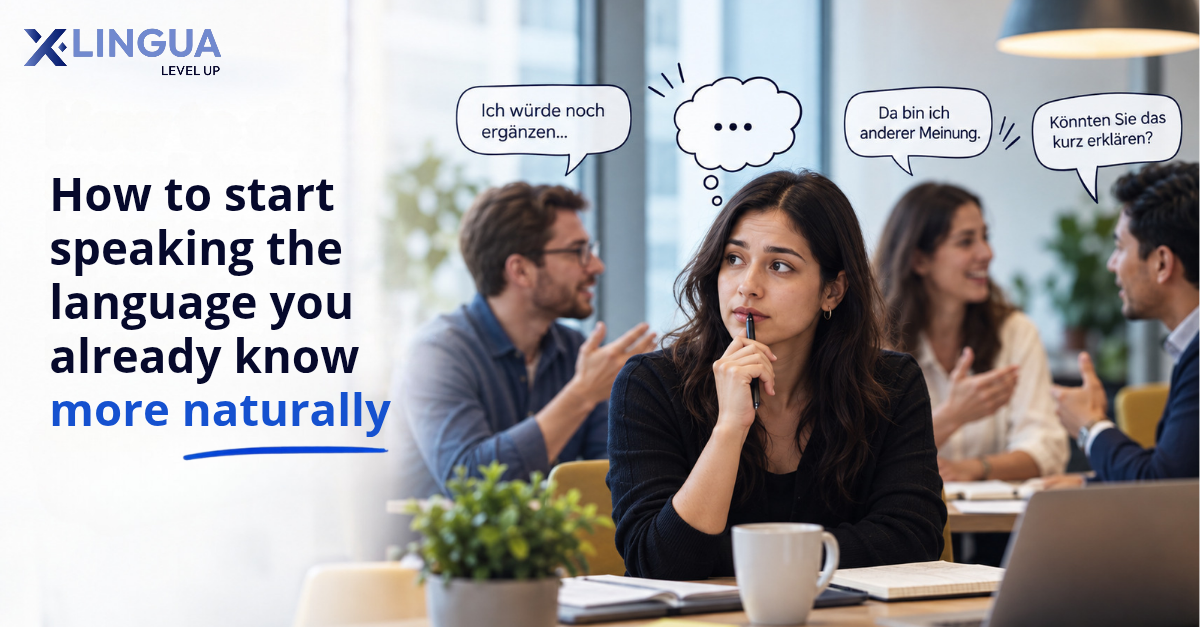
| Entering a discussion | "Darf ich kurz etwas ergänzen?" | May I add something briefly? |
| Handling a dialect switch | "Könnten wir kurz auf Hochdeutsch wechseln?" | Could we switch to Standard German for a moment? |
| Asking for clarification | "Könnten Sie das bitte noch einmal anders formulieren?" | Could you rephrase that, please? |
Common mistakes professionals make
- Over-softening written requests until the actual ask isn't clear anymore.
- Assuming a strong Standard German level covers informal workplace conversation, when it mainly covers the formal, written layer.
- Assuming every meeting will be equally blunt or equally formal, rather than reading the room, since this varies by company and industry.
- Avoiding small talk entirely out of fear of Swiss German, rather than picking up a phrase or two.
- Preparing heavily for the presentation itself and not at all for the Q&A that follows.
How XLINGUA supports this
Generic business German courses tend to teach vocabulary lists organised by topic: meetings, negotiations, presentations, detached from how those situations actually unfold. XLINGUA's approach, built on the XLINGUA Flow™ method, works the other way: real workplace scenarios, rehearsed live, with correction happening in the moment rather than after the fact.
It's the same shift a project manager among XLINGUA's students pointed to when she said the course gave her the confidence to finally lead her team in Zurich, not a vocabulary upgrade, but the ability to actually use what she knew. Corporate programmes are scoped around the actual situations a team faces, not a generic curriculum retrofitted for the Swiss market.
Conclusion
Workplace German in Switzerland isn't a fixed formula of "formal means Hochdeutsch, informal means dialect." It's a moving target that depends on the company, the team, the canton, and who's in the room, and the real skill is staying confident while that target shifts. That's the Speaking Gap™ at work: not a vocabulary problem, but the ability to keep communicating when the linguistic ground moves under you.
Not sure where your own gaps are: meetings, writing, or navigating the shift between languages? Book a free consultation, and we'll help you figure out what to prioritise first.
Frequently asked questions
1. Is workplace German mostly Standard German or Swiss German?
It depends on the setting. Written communication and mixed or formal meetings tend to lean towards Standard German, while internal conversation among Swiss German-speaking colleagues can happen entirely in dialect. There's no single rule, it varies by company, team, and canton.
2. Why do some Swiss colleagues seem direct in meetings?
Concise, matter-of-fact communication is common in many Swiss professional settings, but it's a tendency, not a universal rule. Plenty of organisations and industries lean formal and diplomatic instead. It's worth reading the room rather than assuming one style applies everywhere.
3. How do I prepare for the Q&A part of a presentation if my German isn't fluent?
Preparing a few standard clarifying phrases in advance, like asking someone to repeat or rephrase a question, removes a lot of pressure in the moment, since Q&A is naturally less scripted than the presentation itself.
4. Do I need to learn Swiss German for networking events?
Not fluently, but recognising a phrase or two makes a noticeable difference in how included someone feels. There's no fixed pattern to when small talk shifts between Swiss German, Standard German, or English, it depends on who's speaking.
5. What's the most common mistake newcomers make in written German at work?
Over-softening a request with unnecessary qualifiers until the actual point gets lost. Swiss business writing tends to reward clarity over cushioning.

Eveline Rosa
Gründerin & Ausbildungsleiterin
Eveline Rosa ist die Gründerin von XLINGUA. Als erfahrene Linguistin und Coach hat sie sich darauf spezialisiert, Expats, Führungskräften und Teams dabei zu helfen, Sprachbarrieren in der Schweiz schnell zu überwinden und selbstbewusst zu kommunizieren.